Your Roadmap Is Not a Promise to Preserve the First Solution
Changing a product roadmap is often treated as evidence that the original plan failed.
The team committed to a feature, market, or delivery model. Moving away from it can feel like admitting that the planning was wrong.
The approved route can still become the wrong route
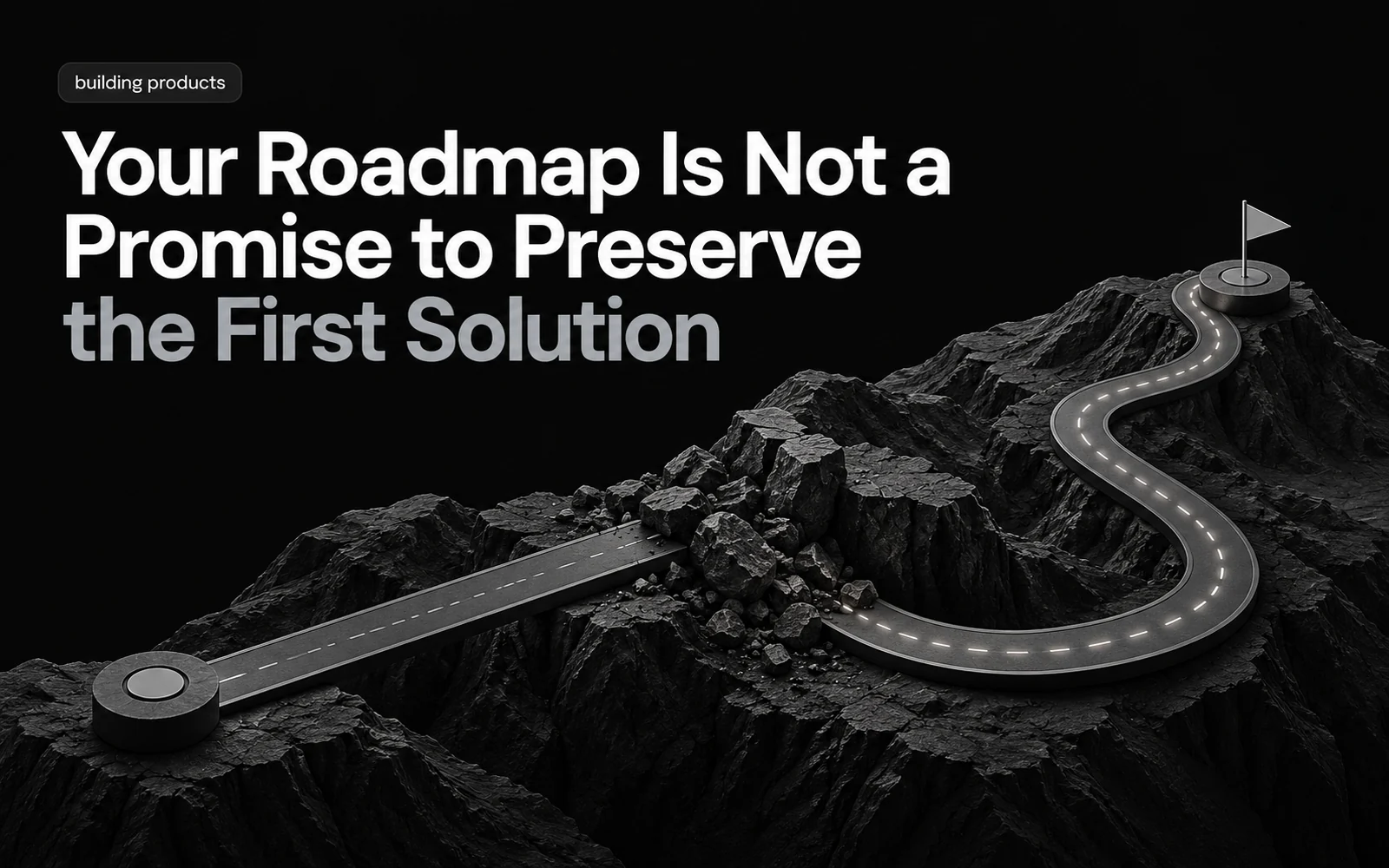
Imagine driving to the airport with a route prepared in advance.
Halfway there, the road closes.
Refusing to turn because “this was the approved route” does not demonstrate discipline. It makes you late.
The destination may remain exactly the same while the route changes. In other situations, new information may reveal that the destination itself should change.
Product work contains both kinds of decisions.
A team may preserve the customer outcome while finding a better implementation. It may simplify the product around the behavior users value most. In rarer cases, it may discover that something created along the way is more valuable than the original business.
Several major products illustrate these different levels of change.
Instagram removed most of the original product
Instagram did not begin as the focused photo product people recognize today.
Kevin Systrom has described how the team moved away from a broader application by removing features and concentrating on the photo experience.
The useful lesson is not that every complicated product should delete most of its features.
It is that an early implementation should not become more important than the evidence showing where the product’s real value exists.
When one part of a product creates significantly stronger pull, simplifying around it may be more disciplined than continuing to complete the original feature list.
Slack found the product inside another company
Slack’s own history explains that the software began as an internal communication tool for the team building a game called Glitch.
When the company shut down the game, the team developed the communication tool for wider use.
This was larger than rerouting the original product. The valuable destination changed.
The original work was not meaningless because the game did not survive. Building and operating it exposed a problem and produced a tool whose value extended far beyond the game itself.
A failed original product and a valuable discovered product can exist in the same story.
Netflix changed how it delivered the outcome
Netflix began as an online DVD rental business. Its early service delivered physical discs through the mail.
In 2007, Netflix introduced immediate viewing on personal computers while continuing its DVD service. Streaming expanded over time, and the company eventually ended DVD delivery in 2023.
The delivery model changed dramatically.
The underlying customer outcome remained more consistent: giving people convenient choice and control over watching films and series at home.
Netflix is therefore a useful example of preserving a broader destination while changing the route as technology and opportunity evolve.
Adaptation is not random movement
These stories do not justify changing direction every week.
One customer comment, competitor announcement, social trend, or internal opinion is not automatically sufficient evidence for a roadmap change.
Before revising the plan, ask:
- What new evidence appeared?
- Is it repeated or isolated?
- Does it come from the market and users the product intends to serve?
- Does it reveal a better way to achieve the same outcome?
- Does it reveal a genuinely more valuable outcome?
- What earlier assumptions no longer hold?
- What does the company give up by changing direction?
- Which part of the strategy should remain stable?
Separate the outcome from the current solution
Roadmaps become unnecessarily rigid when a feature or implementation is written as though it were the business objective.
“Build a new reporting dashboard” is a solution.
“Help operations leaders identify failed work before customers are affected” is an outcome.
If research reveals that alerts inside an existing workflow solve the problem better than a new dashboard, the team should be free to change the route without being accused of abandoning the plan.
Keeping the desired outcome visible gives the roadmap enough stability to guide the company and enough flexibility to respond to evidence.